-
Dates:Sept 12 - Nov 27
-
Running time:approx. 3 hrs incl. interval
-
Language:Italian, Swedish surtitles
-
Stage:
During a dramatic 24 hours we follow the three main characters in a story of life and death, accompanied by surgingly beautiful music, in a classic performance. Tosca is the opera that has it all, here produced with a grand set design, a large chorus and some of the best loved duets in operatic history.
“Vissi d’arte” – “I lived for art” – sings Floria Tosca in the famous aria when confronted by her fate in the second act. Stellar soloists Christina Nilsson, Malin Byström and Elisabet Strid have all performed this iconic soprano role before. This autumn, they will alternate in the role of interpreting the beleaguered heroine in this dark gem of a classic, presented in an elegant visual setting.
What happens in Tosca?
The action takes place in Rome in June 1800.
Read the complete synopsis here
Act I
Cesare Angelotti, an escaped political prisoner, rushes into the church of Sant’ Andrea della Valle to hide in the Attavanti chapel. As he vanishes, an old Sacristan shuffles in, praying at the sound of the Angelus. Mario Cavaradossi enters to work on his portrait of Mary Magdalene – inspired by the Marchesa Attavanti (Angelotti’s sister). Mario contrasts the beauty of the marchesa with that of the woman he loves, the singer Floria Tosca. The Sacristan mumbles disapprovingly and leaves. Angelotti ventures out and is recognized by his friend and fellow liberal Mario, who gives him
food and hurries him back into the chapel as Tosca is heard calling outside. Forever suspicious, she jealously questions Mario, then prays, and reminds him of their rendez-vous that evening at his villa efter her performance. Recognizing the marchesa’s likeness in the painting, she explodes with renewed sus-picions, but he reassures her. When she has gone, Mario summons Angelotti from the chapel; a cannon signals that the police have discovered the escape, so the two flee to Mario’s villa.
Meanwhile, the Sacristan returns with choirboys who are to sing in a Te Deum. Their excitement is silenced by the entrance of Baron Scarpia, chief of the police, in search of Angelotti. When Tosca comes back to her lover, Scarpia shows her a fan with the Attavanti crest, which he has just found. Thinking Mario faithless, Tosca tearfully vows vengeance and leaves. Scarpia has the diva trailed scheming to get her in his power.
Act II
In the Farnese Palace, Scarpia anticipates the pleasure of bending Tosca to his will. The spy Spoletta arrives, not having found Angelotti; to placate the baron he brings in Mario, who is interrogated while Tosca is heard singing a cantata at a royal gala on the other side of the courtyard. She enters just as her lover is being taken to an adjoining room: his silence is to be broken under torture. Unnerved by Scarpia’s questioning and the sound of Mario’s screams, she reveals Angelotti’s hiding place. Mario is carried in; realizing what has happened, he turns on Tosca, but the officer Sciarrone rushes in to announce that Napoleon has won the Battle of Marengo, a defeat for Scarpia’s side. Mario shouts his defiance of tyranny (»Vittoria!«) and is dragged to prison. Scarpia, resuming his supper, suggests that Tosca yield herself to him in exchange for her lover’s life. Fighting off his embraces, she protests her fate to God, having dedicated her life to art and love. Scarpia insists, but Spoletta interrupts: faced with capture, Angelotti has killed himself.
Tosca, forced to give in or lose her lover, agrees to Scarpia’s proposition. The baron pretends to order a mock execution for the prisoner, after which he is to be freed; Spoletta leaves. Scarpia prepares a safe-conduct for the lovers. When he embraces her, Tosca, stabs him with a knife from the table, wrenches the document from his fingers and slips from the room.
Act III
The voice of a shepherd boy is heard as church bells toll the dawn. Mario is led to the roof of Castel Sant’Angelo prison to await execution; he bribes the jailer to convey a farewell note to Tosca. Writing it, overcome with memories of love, he gives way to despair. Suddenly Tosca runs in, filled with the story of her recent adventures. Mario caresses the hands that committed murder for his sake, and the two hail their future. As the firing squad appears, the diva coaches Mario on how to fake his death convincingly; the soldiers fire and depart. Tosca urges Mario to hurry, but when he fails to move, she discovers that Scarpia’s treachery has transcended the grave: the bullets were real. When Spoletta rushes in to arrest Tosca for Scarpia’s murder, she cries to Scarpia to meet her before God, then leaps to her death.
-
Act 1
-
Interval
-
Act 2
-
Interval
-
Act 3
Performance images
-
-
-
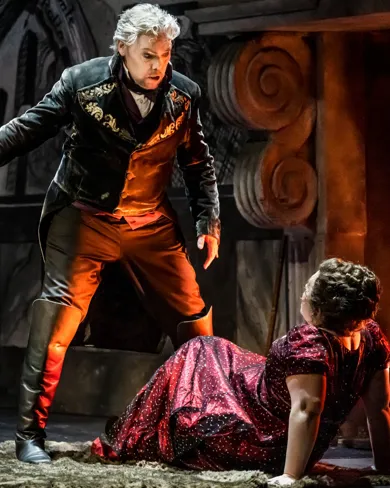
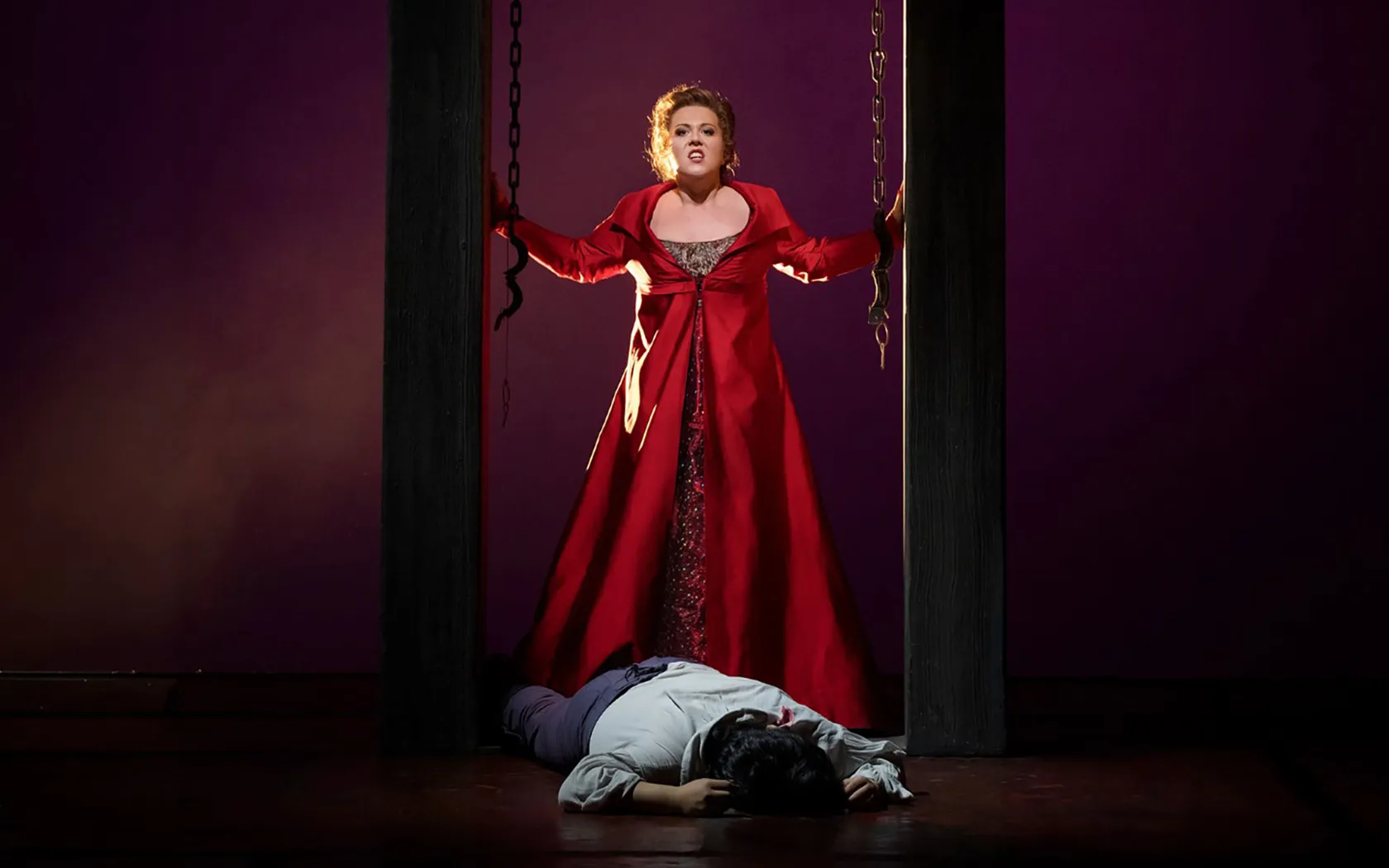
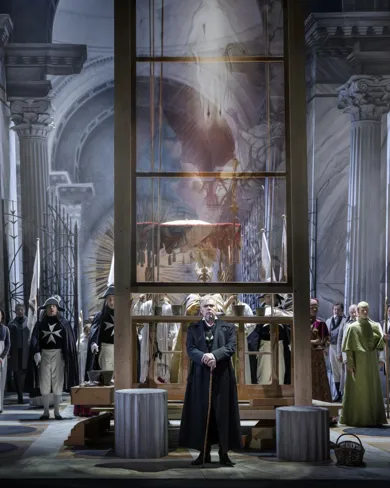
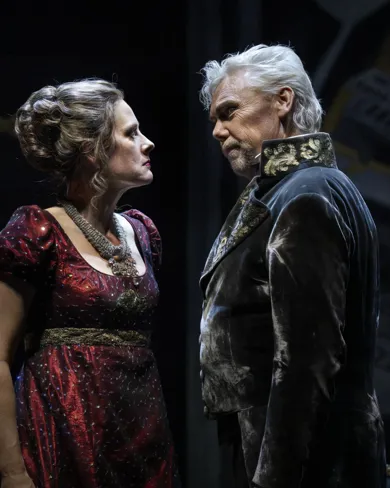
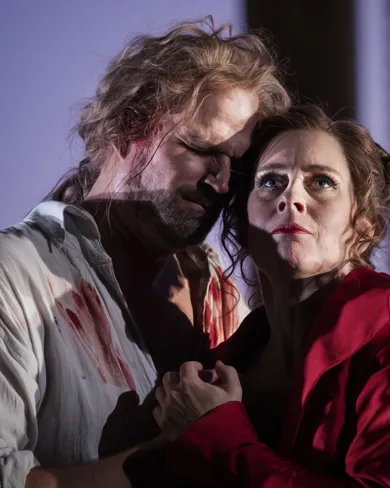
Tosca - performance photo from 2023 -
-
-
-


-
Cast
-
-
Music & creative team
MUSIC Giacomo Puccini
LIBRETTO Giuseppe Giacosa and Luigi Illica, after Victorien Sardou
CONDUCTOR Vitali Alekseenok/André Callegaro
DIRECTOR Knut Hendriksen
SET DESIGN Björn Brusewitz
COSTUME & MASK DESIGN Ann-Mari Anttila
LIGHT DESIGN Hans-Åke Sjöquist
CHORUS MASTER Jori Klomp
Cast subject to change.
Your visit to the Opera


Frequently asked questions
-
At what time do I have to be at the Opera before the performance?
We recommend that you arrive at least half an hour before the performance begins. If you can arrive earlier, it's even better: 45 minutes before the start of the performance, there is a free audience introduction in the Golden Foyer - an excellent way to approach the performance! Please note that once the performance has started, no one will be allowed into the hall until after the first intermission.
-
It's my first time at the Opera - what do I do?
We have put together some useful tips for your visit. Otherwise, our best advice is to arrive on time - discover the Opera House, leave your coat in the cloakroom, eat or drink something. AND, ask our ushers - they'll be happy to help! Outerwear and bags should be left in the cloakroom for safety and evacuation reasons.
-
Can my ticket be rebooked or cancelled if I or someone in my party is ill?
You can rebook tickets yourself on the website up to 24 hours before the start of the performance within the the current season. Tickets cannot be cancelled (read more in our general terms and conditions).
-
Can you eat and drink at the Opera?
Of course you can! Our partner Restaurang Grodan is on the ground floor facing Strömgatan - take the opportunity to book a table ahead of your visit! Each floor also has a service with drinks and snacks, at the stalls' café there is a slightly larger selection. We advice you to pre-book the intermission service so it is ready and waiting for you during the interval!